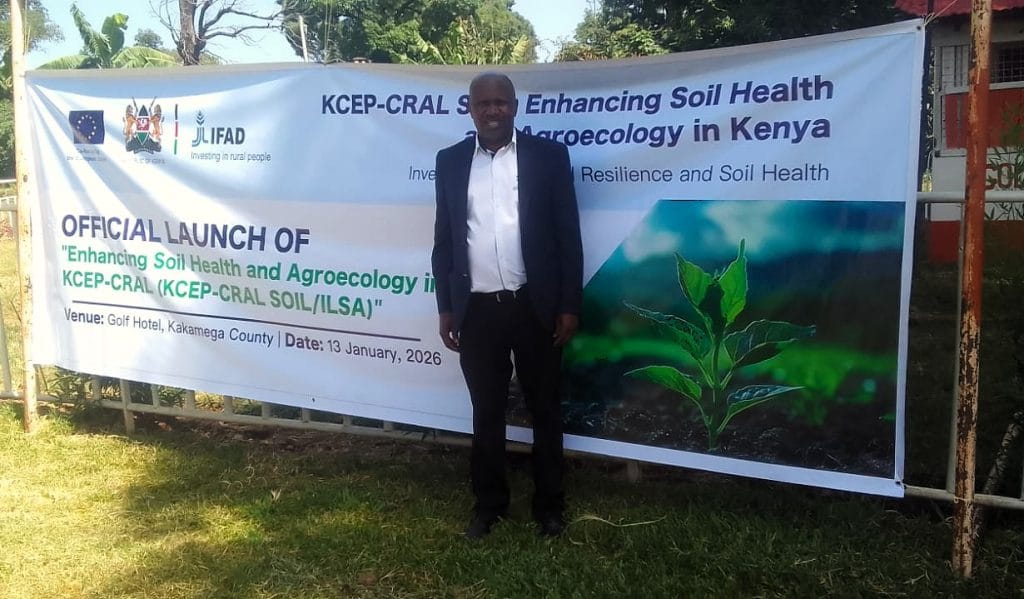
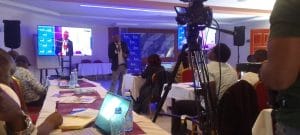
AGMARK attended the KCEP-CRAL ISLA project Kenya launch at Kakamega Golf Hotel from January 13 to January 15, 2026, where stakeholders gathered to drive investments in soil health agroecology across priority counties. The ISLA project Kenya (Investing in Livelihood Resilience and Soil Health) is an EU and IFAD funded action with a €52.5 million budget, and it builds on the earlier KCEP-CRAL work to strengthen resilience and market links for smallholder farmers.
Also Read: AGMARK and AGRA Unite to Empower Women and Youth in Cross-Border Grain Trade
KCEP-CRAL ISLA Project Kenya Launch Stakeholders
The launch brought together EU and IFAD representatives, PCU KCEP-CRAL SOIL officials, national and county Ministry of Agriculture officers, input suppliers, financial institutions, agrodealers, and farmer groups. Dr. Cosmas Munyeke of the PCU outlined a 30 month plan to reach six counties selected for climate vulnerability and agricultural potential. The counties named at the launch included:
- Makueni
- Kilifi
- Embu
- Trans Nzoia
- Kakamega
- Taita Taveta
Exhibitors demonstrated agroecological inputs and smallholder-friendly technologies, while farmers took part in training at demonstration stands. The launch reinforced how policy, research, finance, and private suppliers will link to improve soil management, and it aligned with regional calls for climate smart and regenerative practices seen across Eastern Africa. A large percentage all IFAD projects completed between 2018 and 2023 implemented agroecological practices, climate change adaptation and mitigation initiatives of which informed several launch discussions.
Also Read: AGMARK, Jogoo FM Partner to Boost Cross-Border Trade in Busia, Uganda
Agmark Role and Agrodealer Capacity Building
AGMARK will lead capacity building for KCEP-CRAL agrodealers, preparing training materials and conducting both technical and enterprise management sessions. At the launch, AGMARK CEO Allan Mukisira engaged exhibitors and certified agrodealers, underlining the organization’s role in accrediting and enrolling agrodealers into mobile e-voucher platforms and in supporting linkages with financial partners such as Equity Bank. AGMARK will be responsible for:
- Developing training materials and master trainers
- Enrolling agrodealers on mobile e-voucher platforms
- Validating agrodealers and organizing ToT sessions
- Set demonstration plots and farmer trainings
These actions address a persistent bottleneck in input distribution, because well-trained agrodealers expand access to agroecological inputs at last mile locations. AGMARK’s agrodealer training work builds on lessons from past programs that show a trained agrodealer network improves farmer access and input quality, which in turn strengthens marketable cereal volumes for traders and processors.
Soil Health Challenges and Agroecological Practices
The ISLA project Kenya acknowledges major challenges in soil degradation and climate risk. Sub-Saharan Africa has lost significant land productivity to soil decline, and Kenya faces large areas of arid and semi-arid land, which creates an urgent need for regenerative approaches. Integrating soil testing, digital soil maps, organic fertilizer development, and integrated pest management will be crucial to reverse yield losses and increase resilience. The project’s planned activities include stakeholder sensitization, recruitment of agroecological service providers, demonstration plots, and farmer cost sharing. The main goal is to:
- Use digital soil mapping and testing to match interventions
- Scale biofertilizers and bio-protection to reduce chemical dependence
- Strengthen access to digital finance and e-voucher supply chains
International evidence supports these approaches. For example, FAO soil health strategies recommend integrated management to restore productivity, and the World Bank highlights the need for investment in soil fertility to sustain yields in Africa. By linking trained agrodealers, research institutions such as KALRO, finance partners, and farmer groups, the ISLA project aims to increase food production and improve nutrition while opening opportunities for traders to source higher quality, low-residue cereals that meet export and local market standards.
AGMARK’s participation at the launch and its mandate to train KCEP-CRAL agrodealers will help translate ISLA objectives into practical market-level change. Stakeholders now move to operationalize the activity work plan and enroll agrodealers and farmers; AGMARK encourages partners, agrodealers, and farmer groups to register for upcoming trainings and demonstrations so that local communities can benefit during the project’s 30 month lifespan.