
About AGMARK
Agricultural Market Development Across Africa
AGMARK (Agricultural Market Development Trust) is a Kenyan non-profit social enterprise that strengthens agricultural markets across Eastern, Western and Southern Africa. Founded in 2004 and headquartered in Nairobi, we work through a network of over 12,000 trained agro-dealers serving 2.4 million smallholder farmers in 18 countries.
Our work spans the full agricultural value chain; from input supply at the village level to structured cross-border grain trade, with a focus on building market systems that outlast the projects that fund them.
Why AGMARK
Across East Africa, agricultural development programs face a common structural problem: the networks they build dissolve when project funding ends, and the next program often starts from scratch. AGMARK exists to solve that problem, and the evidence is in the adoption rates.
- We're still based where we started. AGMARK was founded in Nairobi in 2004 by people who grew up in East African agriculture, and that same office is still our only one, twenty-two years on. We've never opened an international headquarters. The field is the headquarters.
- Our networks are built to outlast the project. AGMARK pioneered the Hub and Spoke Model, now widely adopted across the continent: larger hub agro-dealers invest in warehousing and supplier relationships, then supply and mentor smaller rural retailers across a defined circuit. The result is a distribution system that keeps delivering quality inputs to remote farmers year after year, long after any single project has closed.
- Our adoption rates are independently documented. Farmers working through AGMARK-trained agro-dealer networks adopt new technologies at rates of 60 to 90 percent. A University of Nairobi study found AGMARK-trained agro-dealers increased input sales by over 100 percent between 2004 and 2010.
- We are trusted by institutional funders. USAID, the World Food Programme, AGRA, IFAD, the European Union, the African Development Bank, the Rockefeller Foundation, COMESA, AFAP and others have entrusted AGMARK with multi-million-dollar programmes across the region. The Kenyan Ministry of Agriculture requires individuals to be trained by AGMARK to participate in certain government input subsidy programs.
Our Mission
To improve incomes and food security for smallholder farmers across Africa by strengthening the agricultural value chain end to end; from input supplier to last-mile retailer to farmer to output market.
Our work is grounded in a simple operating principle: smallholder farmers adopt climate-smart and regenerative practices when those practices are accessible through trusted local agri-entrepreneurs, economically viable within functioning value chains, supported by technical knowledge and inclusive finance, and connected to reliable output markets where the resulting produce earns a fair price.
What We Do

Empowering Smallholder Farmers
We support smallholder farmers and pastoralists with access to quality inputs, training in agroecological and regenerative practices, and climate resilience tools. Our work reaches farmers through the agro-dealer network rather than direct delivery, ensuring that support continues after project cycles end.

Strengthening Agro-Dealer Networks
We train, certify, and connect agro-dealers across Africa, building the rural distribution backbone that delivers quality inputs to farmers. Our agro-dealer database is among the most complete in Kenya and is referenced by leading stakeholders across the agricultural inputs industry.

Facilitating Cross-Border Trade
Our regional approach strengthens cross-border trade corridors, enabling farmers to access premium markets beyond their national boundaries and agro-dealers to source quality inputs from regional suppliers. Partnerships with CBTAs open economic opportunities, strengthen regional integration, and promote equitable trade practices at key border points.

Driving Agricultural Innovation
We work to encourage the adoption of improved production techniques, expand digital solutions for agricultural extension and market linkages, develop inclusive finance mechanisms for agri-entrepreneurs and farmers, and advance gender equity in agricultural value chains across Africa to advance food resilience and agricultural development across Africa.
Our Approach: The Hub and Spoke Model
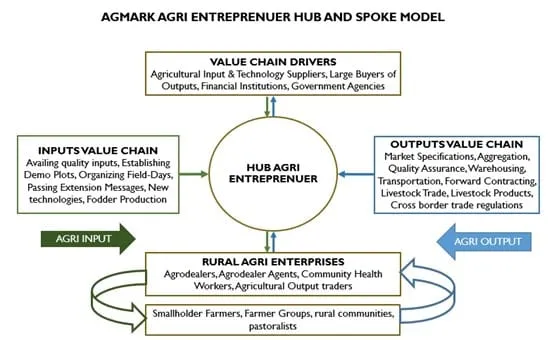
AGMARK pioneered the Hub and Spoke Model, an agro-dealer distribution structure designed to solve the last-mile delivery problem in African agriculture.
Larger hub agro-dealers invest in warehousing, transport, and direct relationships with major input suppliers. They in turn supply smaller spoke retailers across a defined rural circuit, enabling farmers to access premium inputs and agro-dealers to source quality inputs regionally, with technical advice attached.
The model rests on three operational pillars:
- 1. Market Pull
We connect smallholder farmers, input suppliers, output off-takers, and financial institutions into self-sustaining commercial relationships, extended across borders through our regional approach. - 2. Value Chain Competitiveness
We strengthen the efficiency of agricultural value chains end to end (from input supply through production to output marketing) so every actor benefits from improved productivity and market access. - 3. Business Opportunity Viability
We ensure the MSMEs operating within agricultural value chains have viable, profitable business models grounded in demonstrated demand. Profitability sustains the network; the network sustains the farmers.

Major Achievements
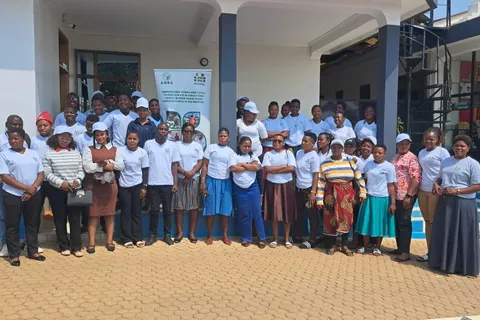
- 12,000+ agro-dealers and agri-entrepreneurs trained and supported across Africa
- 2.4+ million smallholder farmers served through our networks
- 60-90% technology adoption rates among farmers accessing hybrid seeds and fertilizers
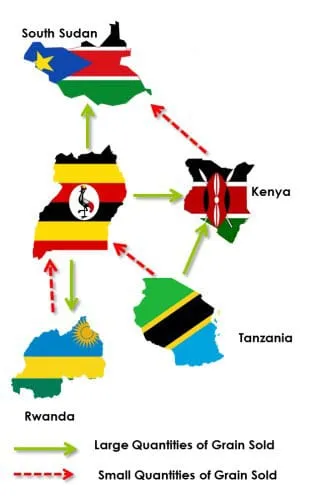
- Regional trade integration enhanced through improved market linkages between smallholder farmers and formal cross-border grain markets
- Structured grain trade improved through certified agri-entrepreneurs engaging in output marketing across national boundaries
- Enhanced food security through increased productivity and market-responsive production at regional scale






Our Partners
























Partner with Us
We work with institutional funders, bilateral agencies, government counterparts, and co-implementing organizations on agricultural market systems, food security, and cross-border trade across Eastern, Western and Southern Africa. If your organization is exploring a co-designed multi-year program, or wants to understand how the Hub and Spoke Model could apply to your geography, we'd welcome a conversation.
Partner With AGMARK